2026 Guide to Sydney Airport (SYD)
Updated: September 30, 2026
Sydney Airport, officially known as Sydney Kingsford Smith Airport (SYD), is Sydney’s primary international gateway, located approximately 8 km (5 miles) south of the central business district. It features three passenger terminals: Terminal 1 handles all international flights, while Terminal 2 and Terminal 3 handle domestic and regional services.
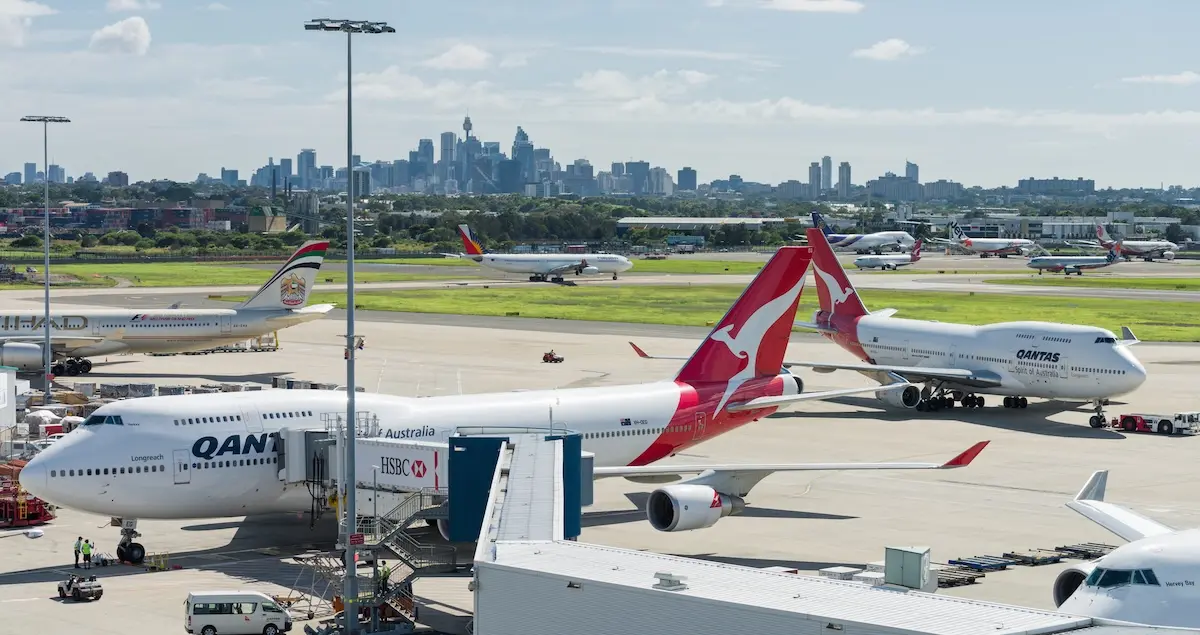
Operating since 1919, Sydney Airport has grown from a small airfield into Australia’s primary international gateway. As Australia’s busiest aviation hub with over 42.54 million passengers in 2025, Sydney Kingsford Smith Airport is the airport of choice for both business travelers and vacationers.
While navigating an airport of this scale can seem like a complex undertaking, SYD is a well-oiled machine and straightforward once you understand how its international and domestic sections work.
This guide will give you all the information you need to make your journey as smooth as possible.
Note: Travelers should be careful not to confuse Sydney Kingsford Smith Airport (SYD) with Western Sydney International Airport (WSI) at Badgerys Creek. WSI is a separate, curfew-free airport opening to passengers on October 25, 2026, and primarily serving Western Sydney.
Sydney Airport at a glance
Official name: Sydney Kingsford Smith Airport
IATA code: SYD
Location: Mascot, New South Wales (Botany Bay area)
Distance to Sydney CBD: 8–9 km (approx. 5 miles) south
Terminals: 3 active terminals (T1 International; T2 & T3 Domestic)
Night curfew: Most aircraft operations are restricted between 11:00 PM and 6:00 AM
Where is Sydney Airport?
Sydney Airport sits in the southern suburb of Mascot, along the northern shores of Botany Bay. Its central position makes it one of the closest major international hubs to a city center anywhere in the world. Under normal traffic conditions, driving between SYD and downtown Sydney takes just 15 to 20 minutes via the M8/WestConnex network or Southern Cross Drive.
Planning for curfew
Because of its urban location, Sydney Kingsford Smith Airport operates under a mandatory legislated night curfew, between 11:00 PM and 6:00 AM. Most passenger aircraft cannot take off or land during this time, although limited exceptions and approved movements apply.
If arriving on a delayed late-night flight or taking an early morning departure, keeping this curfew in mind will help to prevent unexpected itinerary surprises.
Travelers with overnight connections should look into staying at a nearby hotel.
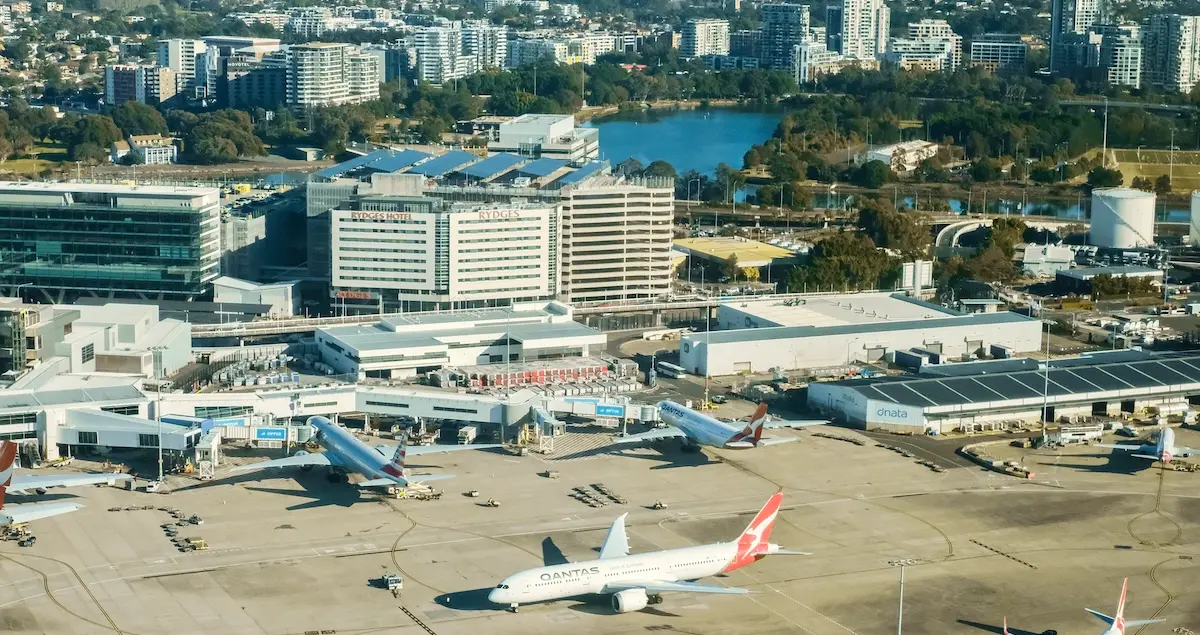
Sydney Airport terminals overview
Understanding how the Sydney Airport terminals are split is the single most important part of navigating your trip smoothly.
Before arriving, reviewing a standard Sydney Airport map shows that the airfield divides between the international precinct (west of the runways) and domestic terminals (east of the runways):
Terminal 1 (International): T1 handles all international arrivals and departures. It operates as a distinct ecosystem on the western side of the airport precinct. It includes multi-level concourses featuring international check-in desks, passport control, duty-free plazas, and airline lounges.
Terminal 2 (Domestic): T2 serves a range of domestic and regional airlines, including Virgin Australia and Jetstar. Located on the eastern side of the airfield, it’s a busy, high-volume terminal with a shared central food court and gate fingers. It’s currently undergoing redevelopment, which is expected to conclude by the end of 2026.
Terminal 3 (Domestic): T3 sits directly adjacent to T2 on the eastern precinct and hosts Qantas domestic and QantasLink regional flights. During the current T2 redevelopment, some other domestic departures also operate from T3. T3 features streamlined check-in facilities, dedicated security lanes, and direct access to Qantas domestic lounges.
How to transfer between Sydney Airport terminals
A common point of confusion at SYD is transferring between international and domestic flights. Because T1 and T2/T3 sit on opposite sides of active runways, walking between the international and domestic precincts is impossible. If your itinerary involves a Sydney Airport terminal transfer, plan your transition using one of these methods:
Between T2 and T3 (Domestic to Domestic): T2 and T3 sit side-by-side on the eastern end. You can easily walk between them landside in about 5 minutes via a covered walkway.
Between T1 and T2/T3 (International to Domestic):
Free terminal transfer bus: Sydney Airport operates a complimentary shuttle between T1 and T2/T3. It takes around 10 minutes and is the simplest option for many passengers who do not qualify for an airline-operated transfer.
Airport Link train: The train takes just two minutes between the International and Domestic stations but requires a fare.
Airline transfer services: Eligible Qantas and Virgin Australia connecting passengers may have access to dedicated airline transfer services; confirm eligibility directly with the airline.
How to get from Sydney Airport to the city center
When considering how to get from Sydney Airport to city destinations like the Sydney CBD, Darling Harbour, or Barangaroo, travelers have several distinct transport options depending on budget, luggage, and timing:
Pre-booked private transfer: Takes 15 to 25 minutes at a fixed premium rate. Best for stress-free door-to-door comfort, business travel, and families with heavy luggage.
Airport Link train: Around 13 minutes to Central. Airport station access attracts an additional fee, so fares are significantly higher than a standard Sydney suburban rail journey; check current Transport for NSW pricing before travel.
Rideshare/taxi: Takes 20 to 35 minutes and costs anywhere from $55.00 to $90.00+ AUD, depending on meter rates or surge pricing. Best for small groups willing to wait in designated airport pickup zones.
Public bus (Route 420): Takes 40 to 60 minutes at standard Opal card fares. Best for ultra-budget travelers connecting to nearby suburbs. Transfer at Mascot for the CBD.
Train vs. private transfer: Making the right choice
The Airport Link train is fast, taking just 13 minutes from the terminal basement stations to Central Station. However, the airport station carries a mandatory airport station access fee per person, which quickly adds up for couples, families, or small groups. Additionally, once you reach Central, Town Hall, or Wynyard, you must still navigate street levels or hail a cab with your luggage.
Opting for a private Sydney airport transfer provides a seamless alternative. A professional chauffeur meets you in the arrivals area, assists with your luggage, and takes you directly to your hotel or destination without another transfer in the city.
Airlines flying from Sydney Airport
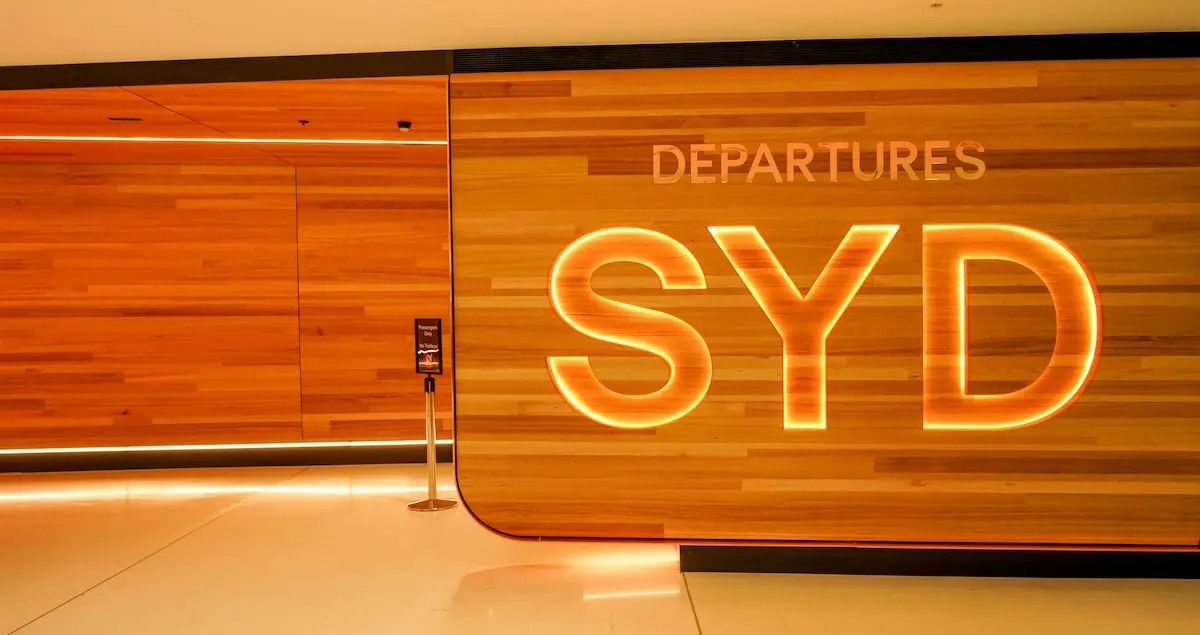
SYD serves as the main international gateway for Australia, managing high volumes of daily Sydney Airport arrivals and departures across global flag carriers and domestic networkers.
Terminal 1 (International): Qantas (International), Air New Zealand, Singapore Airlines, Emirates, Qatar Airways, Cathay Pacific, United Airlines, Delta Air Lines, British Airways, China Southern, Etihad Airways, and others.
Terminal 2 (Domestic): Virgin Australia, Jetstar, Regional Express (Rex), FlyPelican. Note: for the duration of 2026 T2 developments, Rex and FlyPelican departures are currently operating from T3, while their arrivals remain at T2.
Terminal 3 (Domestic): Qantas (Domestic) and QantasLink.
Lounges at Sydney Airport
Whether you need a quiet executive desk, shower facilities, or a premium meal before a long-haul flight, Sydney Airport has a strong selection of airline, membership, and pay-to-use airport lounges across its three terminals.
T1 International lounges
Airline lounges: Qantas First Lounge & Business Lounge, Air New Zealand Lounge, Emirates Lounge, and Singapore Airlines SilverKris Lounge.
Pay-per-use and Priority Pass: The House and Plaza Premium Lounges.
Highlights: The Qantas First Lounge in T1 is known for its Neil Perry-designed dining, spa facilities, and distinctive botanical design. Independent lounges like The House and Plaza Premium Lounge offer pay-per-use entry and access via select travel cards.
T2 Domestic lounges
Key options: Virgin Australia Lounge and Rex Lounge.
Highlights: Features the multi-level Virgin Australia Lounge (offering buffet dining, barista coffee, and workspace) alongside the boutique Rex Lounge.
T3 Domestic lounges
Key options: Qantas Chairman’s Lounge, Qantas Club, and Domestic Business Lounge.
Highlights: Dominated by Qantas, featuring dedicated spaces for Qantas Club members, Domestic Business Class passengers, and high-tier frequent flyers.
Restaurants and shopping at Sydney Airport
Dining
T1 International: Offers elevated dining before security and in the departures lounge. Enjoy Australian produce and espresso bars alongside familiar international choices.
T2 & T3 Domestic: Feature expansive dining precincts. T2 highlights vibrant grab-and-go options, craft beer spots, and fresh local seafood counters. T3 offers structured sit-down dining alongside Australian cafe favorites.
Shopping
T1 houses a large Heinemann Duty Free precinct spanning fashion, cosmetics, fine Australian wines, and luxury watches. Both T1 and the domestic terminals host premium regional retailers selling iconic Australian apparel, local artwork, and travel essentials.
Hotels near Sydney Airport
As mentioned, Sydney Airport's passenger terminals close overnight, so travelers with overnight connections should plan on staying at a nearby hotel rather than relying on the terminal as an overnight waiting area.
Whether your departure is early or your arrival late, booking a Sydney Airport hotel directly adjacent to the terminals will save valuable time.
Mantra Hotel at Sydney Airport: Modern, streamlined accommodation located within comfortable walking distance of Terminals 2 and 3.
Rydges Sydney Airport Hotel: Positioned directly opposite Terminal 1 International departures, ideal for international connections or early-morning check-ins.
Citadines Connect Sydney Airport: A stylish, boutique hotel option located in the Mascot airport precinct, featuring a rooftop lounge overlooking the runways.
Novotel Sydney International Airport: Located a short 5-minute drive from T1 along the edge of the Cooks River.
Amenities and practical tips
Luggage storage: Left baggage services are available in T1 (International Arrivals), T2 (Domestic Arrivals) and Smarte Carte in T3, for travelers wanting to explore the city luggage-free during a short layover.
Free Wi-Fi: Complimentary Wi-Fi is available across all three terminals.
Currency exchange: Travelex kiosks and ATMs are situated throughout T1 departures and arrivals.
Shower facilities: Free public shower amenities are available inside T1 (International Departures). You’ll need to bring your own towel and toiletries unless visiting a premium lounge.
What to do on a Sydney Airport layover
SYD's proximity to central Sydney makes it easy to step out and explore the harbor city.
With enough time between flights, you can take a private car into the city center, walk through the historic Rocks precinct, admire the Sydney Opera House, and enjoy lunch along Circular Quay before returning for your onward flight.
International passengers should factor in immigration, baggage, traffic, and the time required to return through security before leaving the airport.
For a step-by-step breakdown on structuring a quick stopover, read our complete guide on how to spend 12 hours in Sydney.
The best way to continue your journey from Sydney Airport

After a long flight, navigating crowded train gates or waiting in long queues is the last thing you want to do.
Booking a private Sydney chauffeur service through Blacklane ensures your arrival at Sydney Kingsford Smith Airport is entirely seamless.
Your chauffeur monitors your inbound flight in real time, automatically adjusting pickup times for early landings or unexpected flight delays.
Airport pickups include up to 60 minutes of complimentary waiting time, giving you room to clear immigration, collect your bags, and make your way through arrivals without feeling rushed. Guaranteed upfront pricing means you never have to worry about surge pricing or unexpected meter spikes during peak traffic hours.
Whatever your destination, Blacklane provides the calm, reliable bridge between your flight and your final stop.
About the author

John Schärges
John Schärges is an internationally published journalist and award-winning copywriter with 15 years of experience, which includes covering global tourism events and serving as an editor for travel guides. He brings his passion for different cultures and over a decade of living abroad to his writing for Blacklane.